- Services
- Dynamic Captions
- Animated Avatars
- BWT Videos
- ChatBot Agents

AI ChatbotsSupport more customers with a friendly greeting and helpful chatbot agent.
- Chatbots Category
- Video Editing

Website Business And Helpful Content Update Recovery
Updated October 2026
How I Recovered My Search Traffic After HCU
TL;DR Summary
You will learn how to align content with user intent, strengthen your site's identity, modernize outdated pages, improve Helpful Content signals, and create content that AI systems can extract, cite, and reuse.
If you want a clear, practical, step-by-step method for recovering traffic for your website business in 2026? Then this page is your blueprint...
What happened is the BIG brand websites with 1000's of pages and already known brand recognition were considered helpful because of the sheer volume of indicators that small businesses just didn't have.
Then, Google decided to go to complete AI search results with zero click responses, as opposed to keyword driven search engine results. Double whammy. First Google cuts you off from search engines, then scrapes your content to populate it's AI model.
To make it worse AI answer machines doesn't give the content creator a chance to attract real visitors because it's chatbot has given out your information ahead of you and without attribution to you. Yeah, that sucks!
Might make you mad enough to want to fight back. Right? This article is about how I did it: I started re-building my identity a long time ago. Didn't think I was gaining anything until HCU reognized my site and traffic not only returned, it got a lot better. Here's what you need to know and how to fix it.
- Brand identity
- Google's Helpful Content system evaluates websites as unified entities, not loose collections of pages. After HCU merged into the core algorithm in 2024, Google began rewarding sites with a clear, consistent identity, who the creator is, what the site is about, and why it exists. Sites that drift across unrelated topics or hide the author get classified as "unhelpful," suppressing every page. Strengthening brand identity means tightening topical focus, showing first-person experience, naming the author (you), and making your website unmistakably you. When Google understands your brand, it can trust your content again.
- Author identity
- Google wants to know who the creator is. Even though AI answers may not show attribution, author identity is a strong authority signal. The more Google knows about you - your history, your niche, your experience - the more confidently it can classify your content as authoritative.
- Topical focus
- Google evaluates your content and classifies it as helpful or unhelpful based on topical consistency. Sites covering too broad a topic or a random mix of unrelated subjects were penalized by HCU. Recovery requires deleting off-topic content, merging weak pages into stronger consolidated URLs, and tightening overlapping topics. Reinforcing brand identity inside your topical content tells Google you are the authority and your content is helpful.
- Experience signals
- Experience signals matter more than keywords in the AI-driven search model. People now search by search intent, not keyword strings. First-person stories, real workflows, and lived experience add depth, completeness, integrity, and originality - all signals AI answer engines prioritize.
Tip: One of my favorite additions to a webpage is the "Tip Box." Simple, easy, and extremely effective. Add a tip box to share a personal experience or insight. I started adding Schema.org markup to my most important pages first - my home page, my about page, and key articles.
- Schema.org markup structure
- Schema markup is one of the most important website business upgrades you can make. Adding structured data tells AI crawlers exactly where to find your content, what it means, and how it should be classified. This strengthens brand identity, authority, and Helpful Content signals - especially when paired with real experience.
AEO Definitions: What You Should Know
Brand Identity: Why It Matters
Strengthening brand identity is the first step in recovery. I had to make my site unmistakably me again. That meant tightening my topical focus, removing old off-topic content, and presenting myself clearly as the creator behind the tutorials, tools, and workflows I publish. Yup, I started repeating my name, brand and experience all over my website.
Google rewards sites that show real experience, real authorship, and a stable niche. Once I made my brand identity obvious (best-website-tools.com) - who I am (Timothy Koen), what I do (website tools), and why my content exists. Google could finally reclassify my site as helpful.
Brand identity isn't about colors, icons and slogans, it's about recognizability and consistency. What Brand Identity means in the new AI search era.
- a clear niche
- a real human creator
- A unified purpose
- Content reflecting real experiences
- Stable publishing history
- A cohesive topic structure
- A real voice and unique perspective
A strong brand identity tells Google the site is created by a real person, it is experience driven and not just another content farm or AI generated pulp fiction. Brand identity is achieved when Google knows who you are, what your site is about andthat you are a real person.
Tip: For BWT's update I remodeled my home page, about, contact and several key article pages first. I added more of my name, my business and my url to my content. I also improved my page metadata to be tighter and more search intent friendly. Namely better titles, keywords and descriptions were optimized for extraction.
How To Optimize For Search Intent
The four main types of searches performed in Google are navigational, informational, commercial and transactional. Search Intent is the reason behind every users' search query. Searchers are now looking for answers, not keywords. A user these days wants to learn something, get a task done, compare solitions, find something or buy something online. Google must decide what your search intent really is.Understanding search intent changes the way you structure your content. Now instead of keyword rich paragraphs you will be striving to satisfy the search intent. People and Google now want short quick answers to questions. Bullet lists, definitions, summaries and entity-indentity sections satisfies this need perfectly.
Your job is to make clear, easily digestable content that solves a problem through personal experience.
When you write your content use < section > tags with clear H2 or H3 headings, and make bullet lists and include definitions. If you don't have these on your page you may be missing out on AI extraction.
Google's Four Main Search Intent Categories
- Informational Intent The user wants to learn something.
Examples: how-to guides, definitions, tutorials, explanations.
- Navigational Intent The user wants to go to a specific website or brand. Examples: "Best Website Tools," "BWT Videos," "YouTube Studio," "go to Grandma's house."
- Commercial Intent - The user wants to compare options before making a decision. Examples: reviews, comparisons, "best website tools for beginners."
- Transactional Intent - The user wants to take action right now. Examples: sign-ups, purchases, downloads, subscriptions.
How to Apply Search Intent To Content Creation
Here are some of the steps you can use to recover from HCU. It is what I did to restore my site's identity.
1. Ask yourself: "What is the user's real intent, what do they really want?"
Example: Search query "website business"
Real intent: "to learn how to build a website that works."
2. Choose the correct intent type. what is the user trying to get done:
- A. go somewhere
- B. compare options
- C. complete a task
- D. collaborate with AI
- E. learn something
You need to identify which search intent your webpage will satisfy and intentionally create your content for that specific type.
Example: Website Business
Search type: Learn something. This page is intended to present a "how to" solution to HCU recovery for a website business. Include steps to follow punctuated with personal experience and examples.
3. Structure your content for AI extraction. AI answer engines prefer content that is in:
- lists
- workflows
- steps
- definitions
- features and Benefits
- examples
- checklists
- sections
4. diversify your traffic sources. Use other methods to promote your website. Start a newsletter, make a YouTube channel, participate in forums and social media. Google likes to see you are no longer search engine dependent for traffic. Google wants you to be a known personality outside the search engines.
Tip: pick 3 other ways to spread information about your website business other than writing content for the webpages. I create for YouTube, Pinterest, Facebook posts, group and forum participation. AND, I have been consistently blogging since 2017 for Best Website Tools.
These techniques make your content more extractable by the AI answer machines. It will help postion your website business to satisfy Google's new entity recognition standards.
5. Write from experience, not theory.
Google rewards:
- personal experience stories
- well defined workflows
- website tools you use
- problems you solved
- lessons learned
Showing expereince is the strongest "helpful content" indicator. It shows you have unique perspective and are speaking from authority.
6. Deliver a solution, not just information.
Search intent is about solutions and outcomes. Your content should provide one or more of these items:
- solve a problem
- complete a task
- answer a question
- deliver actionable steps
- show real outcomes
- guide the user
- reduce friction
- provide clarity
7. Add a next step at the end of your webpages. Every page should end with a direction or a next step. This could be a call to action, a buy now box, a To Do checklist, a small tutorial, or an author's box or list of related articles, or a simple thanks for reading statement.
Example:
***sbi-order-box***
Website Business AEO Features And Benefits
When Google or any modern AI system extracts content from your website, it is not just reusing your information, it's signaling that your content is trustworthy, structured and genuinely helpful
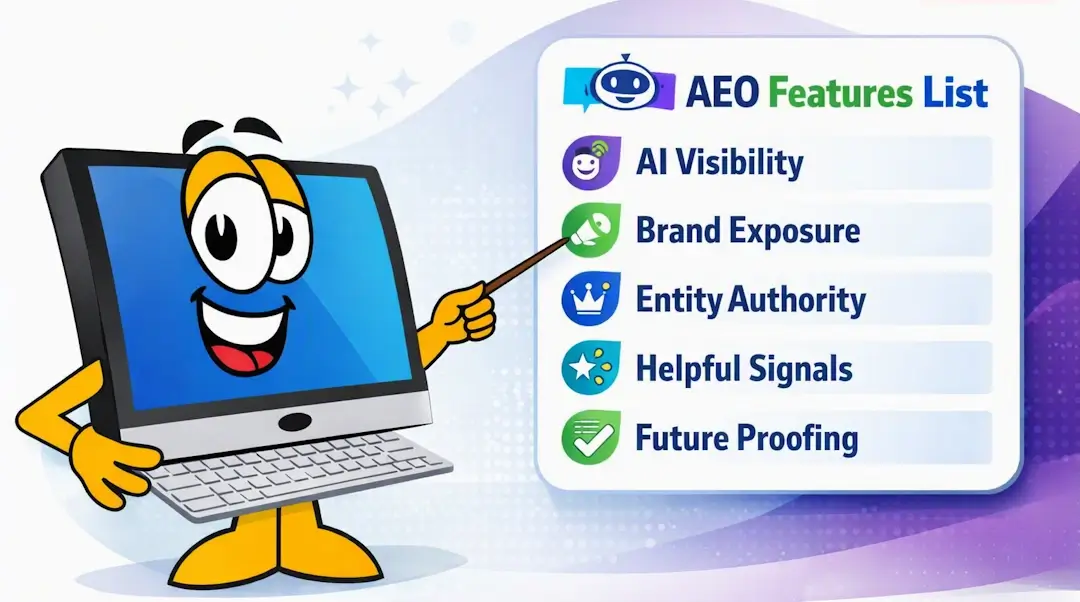
Extraction is one of the strongest indicators that your tutorials, lists, and workflows are valuable enough for AI engines to incorporate into their answers. This creates new visibility, strengthens your brand identity, and positions your site within the emerging AI-driven search ecosystem. Here are the key benefits you gain when your content is extracted:
- AI visibility - your content appears inside AI answers, summaries, and workflows.
- Brand exposure - AI systems cite your site, boosting recognition.
- Entity authority - extraction signals that your site is trusted and authoritative.
- Indirect traffic - users click through for deeper tutorials and real experience.
- Helpful Content signals - extraction tells Google your content is genuinely useful.
- AI-ecosystem reach - your content spreads across Gemini, Perplexity, ChatGPT, Copilot, etc.
- Future-proofing - structured content becomes reusable in AI search layers.
- Workflow inclusion - your tutorials become part of multi-step AI guidance.
- AI backlinks - extraction events act as modern authority signals.
- Search-layer relevance - your site becomes part of the new AI-driven search economy.
After HCU Recovery Plan
Answer engine optimization is a combination of factors. We know that AI friendly content gets extracted from your website business which gives you identity recognition and citation. AI engines look for structured content it can use in it's answer engines.
AI search looks for brand recognition to cite authority and rank your website. So, what to do to recover from Helpful Content update? Follow this guide...
- Clean your website of off-topic pages, irrelevent content and expired information. Do not take a chainsaw approach, pruning shears to reshape it is better. Old content is worth keeping if it adds legacy to your brand.
Tip: Take this page for example. I first made it in 2008. Along the way it got orphaned from my content management system some how and lost to time, untill now. Upon re-discovering it, instead of deleting it, I modernized it and kept the legacy from 2008.
- Search engine optimize your pages first. Modernize your metadata, titles, keywords, descriptions, html code, css files, robot.txt, etc. Do this to your most important pages first. That would be your home/index, about, contact, top tier 2 (categories) pages and your most important tier 3&4 pages.
Tip: Brand identity and search intent are the new formula for website business first page results.
- Answer engine optimize your pages need to be structured for extraction by answer engines, search engines and people alike. Use clear headings to separate your content. Wrap each section with an "id" tag. and give it a logical name Include lists, tables, definitions, headings, section titles and steps.
Tip: Take a close look at this page, literally, inspect the html code and see how the code is structured.
- Consistent publishing is important. Keeping your workflow moving indicates to the AI world that us mere humans are significant for adding value in a timely fashion. Whether you blog, write tutorials or social media share, do it at a consistent pace.
Tip: Blog baby blog, is what I do. Add newly created content to your website business on a regular basis. This action shows consistant publishing and topical authority.
- Add a Table of Contents a ToC goes a long way telling the AI search bots (and people) what your page is about, and a whole lot more data can be mined. It also serves as a navigation structure for the content within your value added content.
Tip: I make a ToC from all my H2 and H3 headings on the page and compile that into a floating dropdown clickable search menu you can see in the upper left corner of this page.
- Add a Frequently Asked Questions (FAQ) section. FAQ's along with Schema code to support it is the best upgrade you can make to your pages (especially tutorials). A FAQ section tells the search bots exactly what they want to hear. It provides quick chewable questions and answers about your topic that AI search bots eat up and spit out.
Tip: I admit I use AI Chatbots to help me write the FAQ code for these because - hey what are digital tools for - it is bigger, better, faster than coding it myself. And it's my content to start with, so it's not cheating, it's multiplying my workflow..
- DO NOT USE AI to write your content for you. I tell everone I know a little secret about writing with AI help. That is; "Just Add You." It is okay to do research and get organized with AI. But there are 2 good reasons to not simply copy and paste AI generated content. A. Intrinsic learning is lost. You are not adding any value. Without adding value you are penalized. B. Plagerism. Copying other people's (even AI generated) content makes you a cheat and a liar and you will be deemed "unhelpful."
What to do? "Just add you." Take the AI generated content and pick it apart, learn it for yourself and then rewrite it in your own words. Do a thorough job of this and add your own insights, inflection and dialect.
- DO USE AI as a tool to assist you with everything other than writing content. This can include writing code, doing research and help with structure like lists, definitions and tables.
Tip: SBI, my CMS webhost has over 50 AI agents that will do all the heavy lifting for you except write content. A new AI focused workflow process is on the horizon. The idea is BBF (Bigger, Better, Faster).
Frequently Asked Questions
When Google or any modern AI system extracts your content, it signals that your page is trustworthy, structured, and genuinely helpful. AI engines reuse high-quality content in their answers, summaries, and workflows, which increases your visibility and authority.
Indirectly, yes. AI extraction strengthens your entity authority and Helpful Content signals. These factors improve how Google understands your site, which can lead to better visibility in both traditional search results and AI-generated answers.
Definitely. AI answers often act as a preview. Users click through when they want deeper tutorials, screenshots, examples, or step-by-step guidance that AI summaries cannot fully provide.
Use clear H2/H3 headings, structured lists, and a logical flow. Include a Table of Contents and write concise, factual sections. These elements make your content easier for AI engines to extract, understand, and cite.
Yes. A ToC helps both readers and AI systems understand your page hierarchy. It improves navigation, extraction accuracy, and overall clarity, making your content more likely to be reused in AI answers.
AEO stands for AI Engine Optimization. It focuses on structuring your content so AI systems can easily extract, reuse, and recommend it. AEO is the next evolution of SEO and is essential for visibility in AI-driven search.
AI citations and extractions increase brand exposure, reinforce your authority, and position your site within the emerging AI-driven search ecosystem. It is one of the strongest modern signals of content quality.

Related Articles:
Easy Blogs Software - learn how to create your own blog/website building platform.
Solo Build Itr - where you can get an all in one online business building system that works.
Search Intent - Google Vs. AI Search engines comparison.
Best Website Tools Categories - all categories in this website
Home : Website Design Tips : Website Business



61 W. Annabelle Ave. Hazel Park,
MI. 48030-1103, U.S.A.
telephone: (248)546-0374
email: support@best-website-tools.com
© Copyright 2007-2026 All rights Reserved.
Sun: closed
Mon-Fri: 9:00AM to 6:00PM
Sat: 9AM-12:00PM
Closed Holidays
